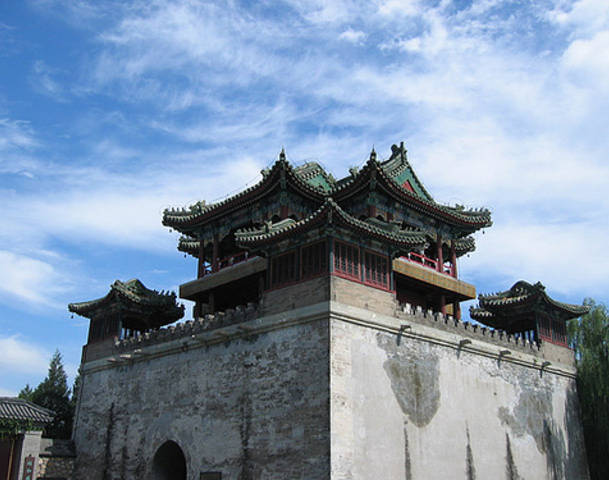
Badaling Great Wall and Summer Palace bus tour is one of the popular
tours in Beijing. Both the Badaling Great wall and summer Palace are the
representatives of China.
Badaling Great Wall is located 60 kilometers northwest of the Beijing
city. It is a mountain corner in Jundu Mountain. The Badaling Great
wall is the main part of the Badaling scenic spot. There is the Badaling
Restaurant, Quanzhou Movie Theater and China Great wall Museum which is
autographed by the chairman Jiang Zemin.
As the world cultural heritage, Badaling Great Wall is famous in the
world for its magnificent landscape, complete facilities and profound
culture history. Dadaling Great Wall has become one of the best spots in
Beijing tour.
Badaling Great Wall is the best protected part in Ming Great Wall and
the representative. It is the essence of the Ming Great Wall and the
important advance guide in Juyongguan. Badaling great Wall is the
exquisite and masterwork in ten thousand li Great Wall. Badaling Great
wall is also the earliest part opened to public. It left deep impression
to the guests in the Badaling Great Wall.
The man who never climbs the Great Wall is not a real man. So the
Badaling Great Wall and Summer Palace tour is popular. Summer Palace is a
famous imperial garden in Beijing. The summer Palace is located in the
quiet and beautiful Beijing northwest rural area. In 1924, the Summer
Palace was opened up. It is also an important witness for Chinese modern
history.
Summer Palace collects the traditional gardening and borrows the
surrounding environment. It not only contains Chinese imperial garden
grand momentum, but also is full of natural fun. The Wanshou Mountain
and Kunming Lake are the basic structure of the Summer Palace. Summer
Palace covers 2.97 square kilometers including three fourths water area.
There are more than hundred buildings, more than 20 yards and more than
3000 ancient rooms. They cover more than 70000 square meters. There are
more than 1600 ancient and famous trees here. The Fuoxiang Pavilion,
long corridor, stone boat, Suzhou Street and seventeen holes bridge and
so on are all the representative architectures here.
During the Badaling Great wall and Summer Palace bus tour, you will
go to visit a jade carving factory and pearl free market. You will know
more about the jade and choose some souvenirs here.
2012年7月6日星期五
2012年6月19日星期二
Beautiful Zhouzhuang China tour
Are you interested in south China or know more about Chinese ancient culture? If so you can have a Beijing package tour
to visit to Zhouzhuang. Escaped from the busy city life, enjoying the
comfortable and charming environment, the unique experience will leave
you a beautiful memory.
Zhouzhuang brings up many spots for its long history. It is not only a
treasure in Jiangsu province, but also a treasure in China. The
environment there is quiet and the architecture is simple but
unsophisticated. More than 60% of the architecture in Ming Qing
dynasties and early Republic of China are well protected including
hundred ancient mansions and more than 60 tile carving gateway arch. The
residences here remain the ancient customs. The most representative
ones are the Shen Hall and Zhang Hall where you must visit during your China City Tour
to Zhouzhuang. The water town architecture style and features are still
well protected even though it goes through more than 900 years'
history.
With lakes on four sides, the beauty of Zhouzhuang is specially to be found along the waterside lanes and around a number of the stone bridges. A different vista at every turn can be found here. All those make a visit most enjoyable. There are many fantastic places and views to visit and see, including Twin Bridges, Fuan Bridge, Shen House, Milou Tower, and more. Many bridges in the town show unique bridge traditions different from other designs. The most amazing view displays a house where a boat can enter the property through the front gate and sail through the courtyard.
Sitting on the boat and visiting the ancient town, it is fun. You can see different scenery after one bridge archway. You will feel like you are in a "bridge, running water and house" picture here. Fuan Bridge is located at the east end of Zhongshi Street, crossing the Nanbeishi River and leading to Nanbeishi Street. It was built in 1355, and later rebuilt. It was the ancient perfect unique architecture as combination of the single-arch bridge. There are towers on all four corners. Each side has carved beams and painted rafters. Tourists now can enjoy the local foods and shopping in the towers there.
Zhouzhuang is a good place to leisure with the quiet and elegant environment. Here you will taste the real ancient water town in China during your China Tour Packages.
2012年6月5日星期二
Join China Tours Make Me Have a Good Holiday
Beijing as the capital city with many world famous history sites is always the first choice for China tours! This bustling city is remaining steeped in China's rich, royal past. China's two final dynasties – Ming and Qing dynasty (1368-1911) and 26 emperors have bestowed Beijing with the richest dynastic heritage in the world, leaves many massive royal buildings!
Enjoy Beijing city tour, you will never miss the world wonder great wall! The Great Wall was built to keep out the warring invaders of the north. Built on the waving mountains, the great wall looked so splendid. There are eight sections of great wall in Beijing, they are Badaling, Mutianyu, Jinshanling, Simatai, Huanghuacheng, Gubeikou, Jiankou, and Juyongguan. The Badaling section is the most well preserved section of the Wall, it is easier to get from Beijing city. You can climb to its top and walk for a mile in either direction: the Great Wall snakes ahead though the mountains as far as you can see. Hiking on other great walls which are further than Badaling will be more exciting with more original styles.
Other famous tourist destinations in Beijing such as Forbidden City, Summer Palace, Temple of Heaven, hutong, ming tombs, etc. are all show you the ancient culture and charm of this ancient city! If you want to appreciate a new Beijing, you can visit the Olympic stadiums which are the new landmarks of Beijing after 2008 Olympic games. Beijing also has much natural scenery for you to relax yourself, just come and enjoy! Take cheap Beijing tour packages including the top attractions in Beijing or take a Beijing sightseeing tours with most popular hotspots are all the great choice!
China has many splendid city offer wonderful travel experience! If you are interested in history and culture, take Xian Tours to enjoy the Terracotta Warriors, take Shanghai tours to Yu Garden and take Lhasa Tour to enjoy the religious architecture and mysterious culture. If you love natural scenery, you can take Yangtze River Cruise, or take a Yunnan tour to the famous Lijiang & Shangri-La, or take a Huangshan tour to the Mountain to enjoy the fabulous sunrise, or take a Guilin tour to Yangshuo, also visit Suzhou, and Hangzhou is a great choice, the landscapes will make visitors feel as though they have stepped into a living traditional Chinese painting.
China has much more to offer, no matter you have several days or just has one day, you can enjoy your time in this great tourist country! Just go!
2012年5月30日星期三
Beijing Travel Review 2012-5-31
For tourists of Beijing tours,
the Peking Opera Show is a good choice in the Beijing night and it is
also a good way to experience traditional Chinese culture.
The excellent Peking Opera Show will be showed in the famous Liyuan Theater. Liyuan Theater is the first tea house style theater opened by Beijing Qianmen Hotel and Beijing Peking Opera Theater in October 1990. It is praised as the "best night stage" in Beijing for seven years. For more than ten years, the Liyuan Theatre performed a total of more than 3,800 games. There are famous and traditional Peking Opera Show troupes every day. The Three Divergences, Farewell to My Concubine, Picking up Jade Bracelet and Steal Silver and so on are all the main plays here. Millions of people leave footprints in the audience including former South Korean President Kim Dae-jung, former Japanese Prime Minister Toshiki Kaifu, Estonian President Lennart Meri, Government officials and other world leaders and famous people.
Liyuan Theater is consisted of play hall, exhibition hall and fairs and sales hall three parts. The play hall is consisted of the stage and audience seats. The stage is eight meters high, twelve meters wide and seven meters deep. On the two sides of the stage, there are the couplets wrote by dramatists Weng Ouhong and Liu Bingsen. Surrounding the auditotium, there are eight large scale Beijing opera facial makeup and 14 Beijing opera figures colored drawing screens. There are totally three ticket sections including 800 seats. The Liyuan Theater is similar to the old opera theater custom. Audience can taste various Beijing snacks and tea when you are enjoying the Beijing opera show. You can also know the more than 200 years' development of the Peking Opera there. If you don't know much about Chinese, it doesn't matter. Most of the audiences in the theater are foreigners and the lists of plays are highlights from operas. In the hall, there is electron show screen. The words of the play can be shown on the screen with both Chinese and English. After the Peking Opera Bus Tour, you will deeply know the Chinese famous opera and enjoy this art.
There are the displays in the exhibition hall about the development of the Peking Opera. Tourists also like to buy some opera handiworks and souvenirs. The unique experience of Peking Opera Show will leave a deep impression on your Tour Beijing.
2012年5月24日星期四
An emerald on the Yangtze
Crisscrossing walkways
offer a panoramic view of the Ancient Pine Tree Garden in Mudu, a water
town near Suzhou, Jiangsu province. [Photos provided to China Daily]
Mudu, near Suzhou, has a history of 2,500 years, but its gardens truly make the town an outstanding place to visit. Pan Zhongming takes a look.
Many water towns in the lower reaches of the Yangtze River are famed for their picture-perfect landscapes, featuring crisscrossing water lanes, with old arch bridges and houses.
Mudu, near Suzhou, in Jiangsu province, however, is the perfect place to savor the charms of these water towns.
The 2,500-year-old settlement is named after wood (mu) and rivers (du) and is full of culture and historical stories.
One of them goes like this: At the end of the Spring and Autumn Period (770-476 BC), the Wu Kingdom and Yue Kingdom were at war. Wu defeated Yue, after which Yue presented the beautiful Xi Shi to the King of Wu, Fu Chai. To please Xi Shi, Fu Chai decided to build Guanwa Palace on Lingyan Hill. For three years, wood was transported to the small town by the side of the hill.
The two kings of Wu also constructed Gusu Terrace, while Qizi Hill is the military fortress built by the Kingdom of Wu.
More than 200 years ago, the imperial painter during Emperor Qianlong's reign, Xu Yang, painted a long scroll depicting views of prosperous Suzhou. Approximately half the scroll depicts Mudu, a town of migrants at the time. There are groceries run by merchants from Hangzhou, salt from Yangzhou, silk from Suzhou and local specialties from Dongting of Suzhou.
Even today, traces of these stores, elegant gardens and simple stone bridges can still be found in the town.
Much of Mudu is behind closed doors. If you are privileged enough to be invited in you may find a private garden, while the owner hosts a poetry contest with his friends by the side of the pond.
Mudu is the hometown of many celebrities. Between 1015 and 1902, there were 24 successful candidates in the highest imperial examinations and 28 provincial graduates originally came from Mudu. These people were prominent in politics, economics, science and culture.
A couplet hanging in Shangxian Hall, of the Yan's Family Garden, illustrates the tradition of showing esteem to prominent people. The garden was originally called Muyuan Garden, meaning "admiring prominent people".
The one-hectare Yan's Family Garden is the former residence of Yan Jiagan, former "president" of Taiwan. The garden's magnolia tree is said to have been planted by Qing Dynasty (1644-1911) Emperor Qianlong when he toured the town and stayed in the compound.
Shangxian Hall is built in the Ming Dynasty (1368-1644) style, out of nanmu wood. The architect Liu Dunzhen dubbed Four-Season Mini-Garden a "classical masterpiece of gardens south of the Yangtze River".
Other gardens in the town are typical Suzhou style, or imperial in construction.
As early as the turn of the Ming and Qing dynasties, the town had more than 30 private gardens. More than 10 remain and have various styles.
Guanwa Palace at Lingyan Hill was the imperial garden built by King Fu Chai, while Lingyanshan Temple on Lingyan Hill and Mingyue Temple at the foot of the hill represent Buddhist culture.
In recent years, Mudu has renovated and opened four gardens - the Yan's Family Garden, Hongyin Shanfang, Ancient Pine Tree Garden and Bangyan's Residential House.
Hongyin Shanfang consists of two Ming-style gardens. Xiaoyin Garden is the former residence of Shen Shou, the "Queen of Embroidery", while Xiuye Garden is now a museum that displays imperial decrees and introductions to the imperial examination system.
Ancient Pine Tree Garden at Shantang Street is known for a 500-year-old pine tree and the well-preserved brick carving at its entrance gate. The garden is the former residence of Cai Shaoyu, a businessman in the late Qing Dynasty.
Bangyan's Residential House is the former residence of political theorist Feng Guifen and has a typical Qing garden. It is famed for its brick carvings, wood sculptures and stone engravings. The garden features a pond, surrounded by pavilions, gazebos, walkways, bridges and rockeries.
It is the gardens of Mudu that truly make this town an emerald among those towns in the lower reaches of the Yangtze River.
订阅:
博文 (Atom)